
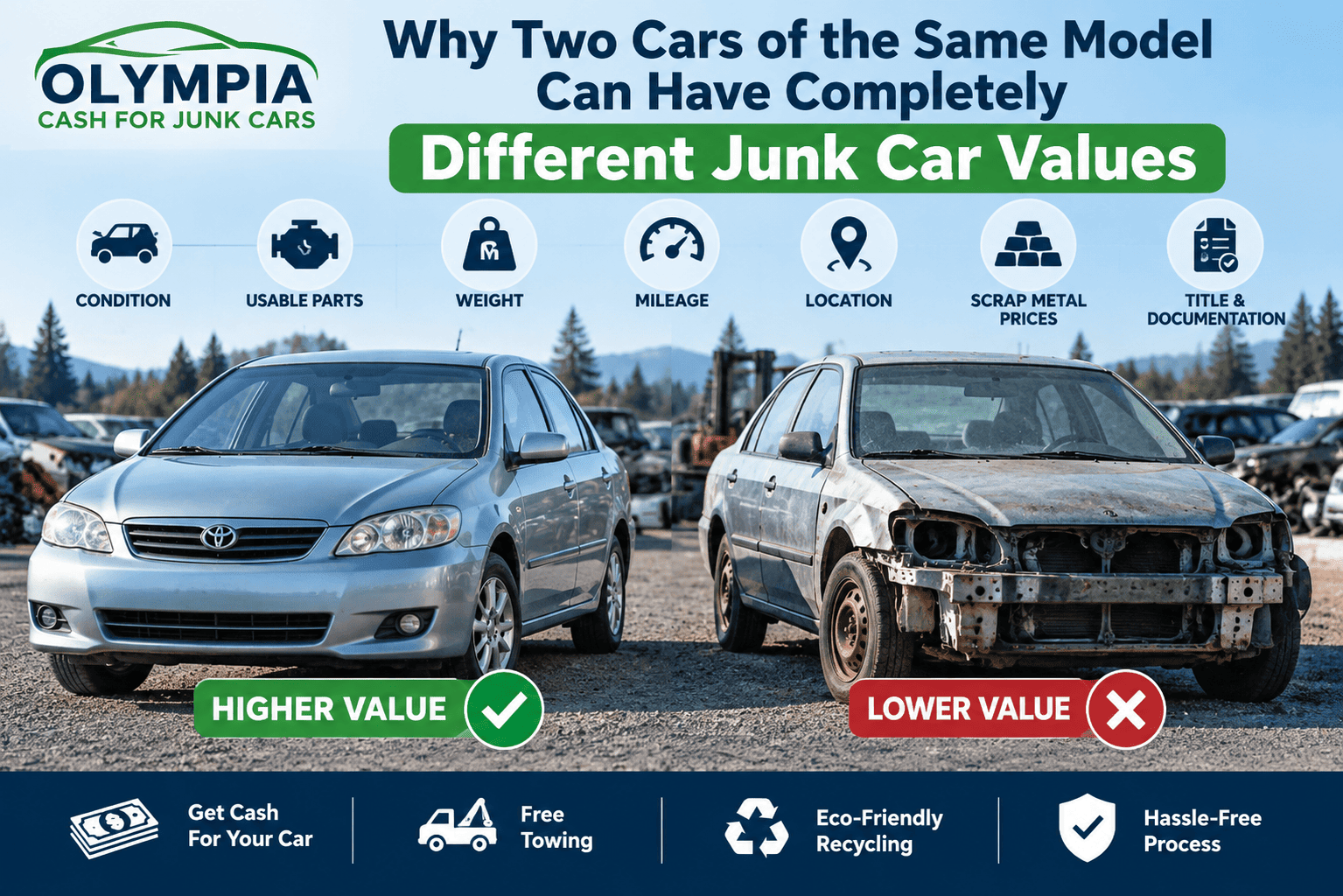
Why can two identical cars have different junk car values? Learn how condition, parts, weight, mileage, location, and scrap prices affect your offer.
At first glance, two cars of the same make, model, and year might seem like they should have nearly the same value. However, when those vehicles are being sold as junk cars, their prices can be surprisingly different. One may receive a much higher offer than the other even though both vehicles share the same model name.
Why does this happen? The answer is that junk car value is based on much more than the badge on the hood. A vehicle's condition, weight, usable parts, location, title status, demand for components, and current scrap-metal prices can all influence what a buyer is willing to pay.
Understanding these factors can help you set realistic expectations when looking for cash for cars Olympia services.
Vehicle Condition Can Make a Major Difference
The overall condition of a vehicle is one of the most important factors affecting its junk value.
Consider two identical sedans. One has a damaged body but a complete engine, transmission, wheels, catalytic converter, and interior. The other has been sitting outside for years and is missing several major components.
Even though the vehicles are technically the same model, they don't have the same value.
A junk car buyer may be able to recover, resell, or recycle useful components from the first vehicle. The second vehicle may have considerably less usable material.
Important condition factors can include:
- Engine and transmission condition
- Body damage
- Rust and corrosion
- Condition of wheels and tires
- Interior condition
- Missing parts
- Water or flood damage
- Fire damage
- Whether the vehicle rolls or can be loaded easily
This is why simply searching for the “value” of a particular model may not provide an accurate estimate for your individual vehicle.
The Weight of the Vehicle Matters
When a vehicle is destined primarily for recycling, its physical weight can have a significant impact on its value.
Cars contain large amounts of steel, aluminum, copper, and other recyclable materials. A heavier vehicle may contain more recoverable metal than a smaller, lightweight car.
However, this doesn't mean that the heaviest car will always receive the highest offer. The actual value can depend on the composition of the vehicle, the amount of recyclable material remaining, and current market conditions for scrap metals.
This is one reason two vehicles that look similar from the outside can still receive different offers.
Usable Parts Can Increase the Vehicle's Value
A junk car isn't necessarily worthless just because it no longer makes sense to repair.
Many vehicles contain components that may still have value. Depending on the model and condition, these could include:
- Engine components
- Transmission parts
- Alternators
- Starters
- Wheels and rims
- Electronic modules
- Body panels
- Seats and interior components
- Catalytic converters
- Suspension components
For example, imagine two identical vehicles with failed engines. One has already had its catalytic converter, wheels, electronics, and several other components removed. The other remains mostly complete.
The complete vehicle may be more valuable because there are more components available for recovery.
Mileage Can Matter, But It Isn't Everything
Mileage is often one of the first things people mention when discussing a vehicle's value. For a traditional used-car sale, mileage can have a substantial influence on price.
For junk vehicles, however, mileage may not tell the entire story.
A high-mileage vehicle can still contain valuable parts. Likewise, a low-mileage vehicle may have significant damage that reduces its value.
For instance, a 100,000-mile vehicle that has been properly maintained and remains relatively complete could potentially be more attractive to a buyer than a 60,000-mile vehicle that has suffered extensive flood damage.
This is why junk car buyers generally consider the vehicle's overall condition rather than mileage alone.
Location Can Affect the Final Offer
Where a vehicle is located can also influence its value.
Transportation costs are an important part of the junk car business. If a vehicle is located far from a processing facility, additional towing and transportation expenses may affect the economics of the purchase.
For someone searching for olympia cash for cars, choosing a local buyer can be particularly convenient because local pickup may reduce some of the logistical challenges involved in getting rid of an unwanted vehicle.
A local service may also understand the types of vehicles commonly found in the Olympia area and the practical requirements involved in arranging pickup.
Current Scrap-Metal Prices Can Change
Another important factor is the market price of recyclable materials.
The value of steel, aluminum, copper, and other metals can change over time. When scrap-metal markets move, the potential value of vehicles sold primarily for recycling can also change.
This means a vehicle that receives one offer today may not necessarily receive the exact same offer months later.
However, scrap value is only one piece of the equation. A vehicle with desirable reusable parts can have value beyond its raw metal content.
Popular Models May Have Stronger Parts Demand
Some vehicles have a large number of owners on the road. When a particular model is common, replacement parts may have consistent demand.
This can make certain vehicles attractive even when they are no longer suitable for normal road use.
A damaged vehicle might therefore have value because of its components rather than because someone wants to drive it again.
The age of the vehicle can also influence this equation. Older models may have fewer replacement parts available through conventional channels, potentially making used components more useful to people maintaining similar vehicles.
Missing Parts Can Reduce a Vehicle's Value
Removing parts before selling a junk car may seem like a good way to make additional money, but it can also reduce the vehicle's overall offer.
If important components are missing, the buyer may have fewer parts to recover and less material to process.
For example, removing the wheels, catalytic converter, engine, or other major components can significantly change the condition of the vehicle being offered.
Before dismantling anything, it is worth asking whether selling the vehicle as a complete unit could provide a better overall return.
Title and Ownership Documentation Matter
The paperwork associated with a vehicle can also be important.
A legitimate vehicle transaction generally requires the seller to establish ownership and follow applicable state requirements. Problems with documentation can complicate the selling process.
Before contacting a buyer, gather the available vehicle information and ownership documents. Having accurate details ready can make it easier to receive an appropriate quote and arrange pickup.
If you're unsure what documentation is required for your particular situation, verify the current Washington requirements before completing the transaction.
Why Online Estimates May Not Match Your Actual Offer
Online calculators can be useful for getting a general idea of what a vehicle might be worth, but they cannot always account for the specific condition of your car.
A calculator may know the make, model, year, and mileage but not know that:
- The engine is missing
- The transmission still works
- The vehicle has severe rust
- The catalytic converter is gone
- The car has valuable original parts
- The vehicle has flood damage
- The car is complete and ready for pickup
These details can significantly change the value.
That's why an actual quote based on the vehicle's current condition can be more useful than relying solely on a generic online estimate.
How to Get a Better Idea of Your Junk Car's Value
If you're preparing to sell an unwanted vehicle, start by collecting accurate information.
Write down the make, model, year, approximate mileage, condition, and major problems. Take clear photos showing the exterior, interior, engine compartment, wheels, and any significant damage.
Be honest about missing parts or mechanical problems. Providing accurate information helps the buyer understand what they're purchasing and can make the quoting process more straightforward.
If you're looking for buy junk cars in Olympia, comparing your options and providing complete vehicle information can help you find a suitable buyer without wasting time.
Final Thoughts
Two cars can have the exact same make, model, and year yet have completely different junk car values. The difference comes from everything that happened to those vehicles after they left the dealership.
Condition, weight, reusable parts, mileage, missing components, location, documentation, parts demand, and recycling-market conditions can all influence the final value.
So, if your vehicle isn't worth repairing, don't assume that its model alone determines what it's worth. A complete assessment of the car can reveal value that isn't obvious at first glance.
For Olympia-area vehicle owners, understanding these factors can make the selling process easier and help you approach a cash for cars Olympia service with realistic expectations. Whether your vehicle is running, damaged, old, or no longer roadworthy, knowing what influences its value is the first step toward making an informed decision.