
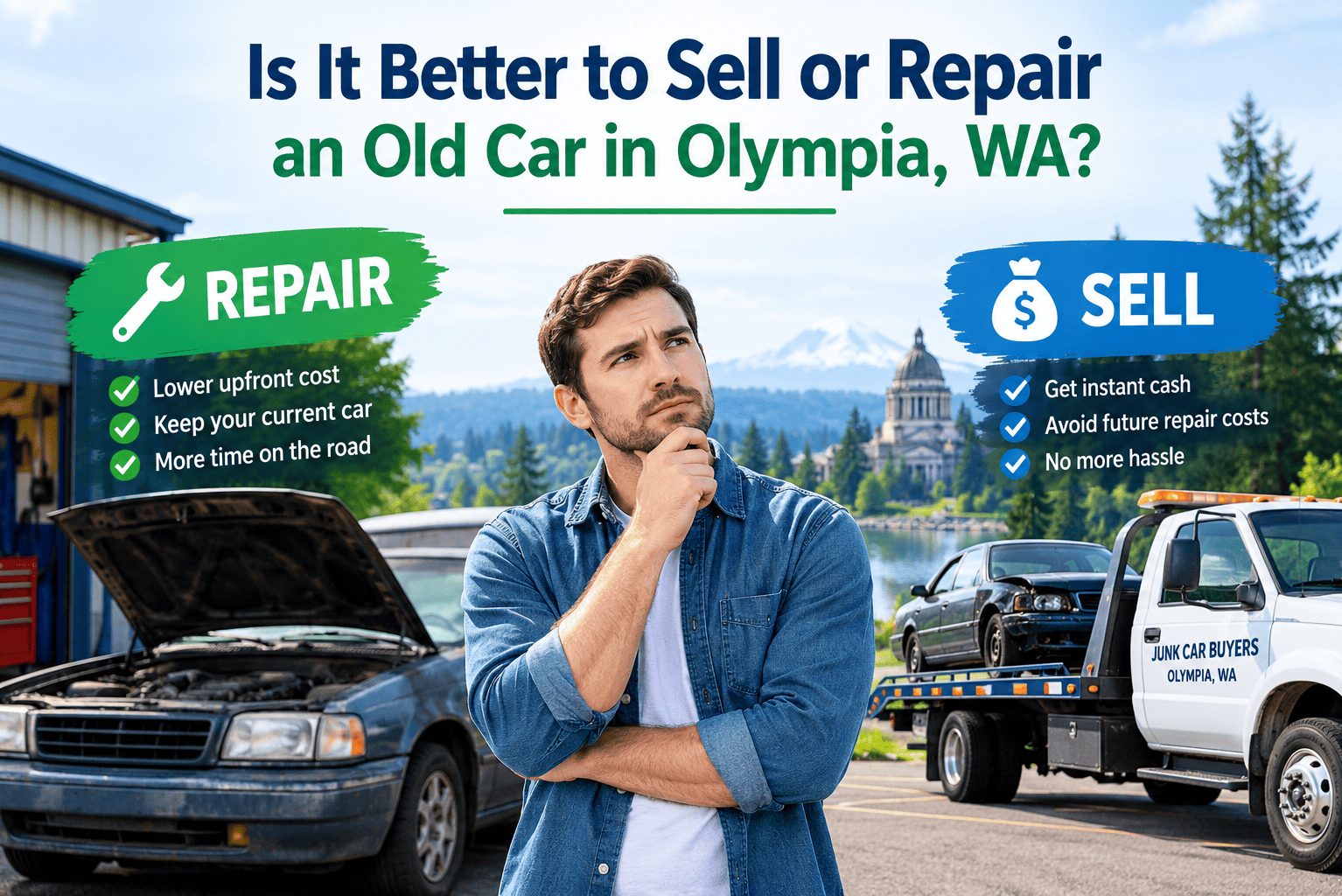
Wondering whether to repair or sell your old car in Olympia, WA? Compare repair costs, vehicle value, and selling options before deciding.
Is It Better to Sell or Repair an Old Car in Olympia, WA?
Owning an old car can be convenient when it runs well, but what happens when repair bills start increasing? You might face a failing engine, transmission problems, worn-out brakes, electrical issues, or rust that makes the vehicle unreliable. At that point, many Olympia drivers begin asking the same question: Should I spend more money repairing my old car, or is it better to sell it and move on?
The right decision depends on your vehicle's current condition, the estimated repair cost, its market value, and how long you expect to keep driving it. Sometimes, a small repair can give your car several more useful years. In other cases, continuing to repair an aging vehicle can cost more than the car is worth.
For vehicle owners considering whether to repair or sell, understanding both options can help prevent unnecessary expenses. If your car is no longer dependable, you can also explore options to sell it to buyers who purchase unwanted, damaged, or non-running vehicles in Olympia, Washington.
1. Start by Understanding Your Car's Current Condition
Before deciding whether to repair or sell your vehicle, take an honest look at its condition. Age alone does not determine whether a car is worth keeping. A well-maintained older vehicle may still be reliable, while a newer car with major mechanical damage might require expensive work.
Consider these questions:
- Does the engine start and run properly?
- Does the transmission shift smoothly?
- Are warning lights appearing frequently?
- Has the vehicle needed several repairs in the last year?
- Is rust affecting important structural components?
- Does the car feel safe and dependable on everyday trips?
If the vehicle needs only routine maintenance, repairing it may make sense. However, if several major components are failing at the same time, selling it could be a more practical choice.
For example, replacing worn brake pads is a different financial decision from replacing an engine and transmission in a high-mileage vehicle. The key is to evaluate the complete condition rather than focusing on a single problem.
2. Calculate the Total Cost of Repairing an Old Car
Repair estimates can make a vehicle owner feel that fixing the car is the obvious choice, especially when the estimate is lower than the cost of buying another vehicle. But the initial repair bill is only one part of the calculation.
Before approving repairs, consider the following expenses:
- Immediate repairs: The work required to make the vehicle reliable or safe again.
- Upcoming maintenance: Tires, brakes, suspension parts, battery replacement, and other aging components.
- Recurring problems: Issues that have returned despite previous repairs.
- Downtime: The inconvenience of being without transportation while the car is in the shop.
- Future reliability: The possibility of additional breakdowns after the current repair.
Ask a mechanic for a written estimate that separates urgent repairs from recommended maintenance. If the work is expensive or complicated, getting a second opinion may help you make a better-informed decision.
For instance, imagine your older sedan needs $1,800 in repairs, and the mechanic identifies another $1,200 in likely maintenance over the coming year. Your expected expenses could reach $3,000 before accounting for other unexpected problems.
That does not automatically mean you should sell the car. If it is otherwise reliable and replacement transportation would be much more expensive, repairing it may still be sensible. The important thing is to consider the complete financial picture.
3. Compare Repair Costs With Your Car's Current Value
One of the easiest ways to approach this decision is to compare the vehicle's value before repairs with its value after repairs.
Suppose your car could sell for $3,500 in its current condition, while repairing it would cost $2,000. You should ask whether the repair will meaningfully improve the vehicle's reliability and resale value.
| Factor | What to Consider |
|---|---|
| Current vehicle value | What could you realistically receive for the car as it sits? |
| Repair estimate | How much will the necessary work cost? |
| Value after repairs | What might the car sell for once repaired? |
| Expected future expenses | Are additional repairs likely soon? |
| Replacement transportation | How much would another dependable vehicle cost? |
Do not assume every dollar spent on repairs will increase the car's resale price by the same amount. Mechanical repairs may make the vehicle easier to sell, but buyers generally consider age, mileage, condition, and demand as well.
If you plan to sell the vehicle immediately, a major repair may not be worthwhile when the increase in resale value is smaller than the repair expense. If you plan to drive it for several more years, the calculation is different because you also benefit from continued use.
4. When Repairing an Old Car Makes More Sense
Repairing your vehicle can be a good decision when the problems are limited, the rest of the car is in good condition, and the cost is manageable.
Consider repairing your car if:
- The problem is relatively minor. Routine maintenance and isolated component failures can be worthwhile to fix when the vehicle is otherwise dependable.
- The car has a strong maintenance history. If you have kept up with oil changes, fluid replacements, and scheduled servicing, you may have a better understanding of its overall condition.
- Major components are still working well. A healthy engine, transmission, and structural frame can make an older car worth keeping.
- You need reliable transportation. Buying another vehicle involves its own costs, including taxes, registration, insurance, and potential repairs.
- The repair provides useful additional service life. Spending money on a vehicle you can comfortably drive for several more years may be more economical than replacing it immediately.
For example, an older car with high mileage but a healthy engine and transmission may only need new tires and routine maintenance. In that situation, keeping it could be more practical than selling it simply because it has passed a certain age.
The goal is not to avoid every repair. It is to avoid investing heavily in a vehicle that is unlikely to deliver enough dependable use in return.
5. When Selling Your Old Car Is the Better Option
Sometimes, repairing an old car no longer makes financial sense. Selling may be the more practical choice when the vehicle has several expensive problems or you no longer trust it to get you where you need to go.
Repeated Breakdowns Are Becoming Expensive
If your car frequently needs repairs, the costs can add up quickly. Even after fixing one issue, another component may fail because of age, wear, or poor overall condition.
Repeated breakdowns can also make everyday life difficult, especially if you rely on your vehicle for work, family responsibilities, or commuting around Olympia.
The Engine or Transmission Has Failed
Major engine or transmission repairs can be expensive. If the vehicle is already old, has high mileage, and needs additional work, replacing these components may not be the best use of your money.
Before deciding, compare the repair estimate with the car's current value and the cost of replacement transportation.
Rust or Damage Affects the Vehicle's Condition
Vehicles exposed to moisture over time may develop corrosion, while accidents can cause mechanical or structural damage. Surface rust is not always a reason to sell, but serious corrosion or structural damage requires careful evaluation.
If the vehicle is no longer safe or needs extensive bodywork, consider selling it rather than continuing to invest in repairs that may not restore its long-term reliability.
The Car Is Sitting Unused
An old vehicle that no longer runs may take up driveway or garage space while you continue to postpone a decision. Depending on its condition, it may still have value to a used-car buyer, salvage buyer, or vehicle recycler.
If you are researching options for selling an unwanted vehicle, compare offers from businesses that purchase junk cars and damaged vehicles in Olympia. You do not necessarily need to restore a vehicle to running condition before exploring a sale.
6. Can You Sell a Car That Needs Expensive Repairs?
Yes. You do not always have to repair a vehicle before selling it. Depending on the buyer, you may be able to sell a car with engine trouble, transmission failure, accident damage, mechanical defects, or other problems.
The available options generally include:
- Private buyers: May be interested in an older vehicle that still runs or can be repaired economically.
- Used-car dealers: May consider vehicles that fit their purchasing requirements.
- Junk car buyers: Often consider vehicles that are damaged, worn out, or no longer running.
- Salvage and recycling businesses: May evaluate a vehicle based on reusable parts and recyclable materials.
The best option depends on the car's condition and how much effort you want to put into the sale. A private sale may be suitable for a vehicle that still has useful life, while a junk car buyer may be more practical for a vehicle with major mechanical problems.
If you are researching cash for junk cars Olympia, request quotes based on the vehicle's actual condition. Share the make, model, year, mileage, known problems, and whether it starts. Ask whether towing is included, what paperwork is required, and how payment will be handled.
Avoid spending money on repairs simply to make the vehicle easier to sell until you have compared the likely sale price with the cost of the work.
7. How Olympia's Local Conditions Can Affect Your Decision
Local driving conditions are another factor worth considering when evaluating an older vehicle in Olympia, WA.
The region experiences regular rainfall, so it is sensible to pay attention to corrosion, moisture-related electrical problems, worn tires, and braking performance. These issues do not affect every vehicle equally, but they can influence maintenance needs and long-term reliability.
Consider how you use your car. A vehicle that makes short trips around Olympia may have different needs from one used for frequent highway commuting or longer journeys across Thurston County.
If you regularly travel to work, transport children, or depend on your vehicle for appointments, reliability may be more important than getting another year or two out of an aging car.
On the other hand, if your vehicle is still dependable and needs only routine maintenance, there may be little reason to sell it solely because it is old.
The best decision is based on the condition of your individual vehicle, not its age alone.
8. How to Compare Cash Offers Before Selling
If repairing the car seems too expensive, get more than one offer before making your final decision. Different buyers may evaluate the same vehicle differently because they have different resale opportunities, parts demand, transportation costs, and recycling arrangements.
When requesting quotes, provide accurate information about:
- The vehicle's year, make, and model.
- Its approximate mileage.
- Whether the engine starts.
- Any known engine or transmission issues.
- Accident damage, rust, or missing parts.
- Whether you have the vehicle title and keys.
Ask whether the quoted amount is final or subject to an inspection. Confirm any towing charges and understand when payment will be provided.
A quote that initially sounds attractive may be less competitive if you must pay extra for transportation or other services. Compare the amount you will actually receive, not just the first number offered.
If you are researching town auto Olympia or other local vehicle-buying options, use the same process for each prospective buyer. Compare the offers, understand the terms, and choose the option that fits your needs.
9. What Paperwork Should You Prepare in Washington?
Before selling an old vehicle in Olympia, check the ownership and paperwork requirements.
The Washington State Department of Licensing explains that sellers generally need the vehicle title or an acceptable alternative ownership document, must complete the relevant transfer paperwork, and must submit a Report of Sale within five days of the sale or transfer. Sellers should also remove their license plates and personal belongings.
Before arranging the sale:
- Locate your title and check that the ownership information is correct.
- Contact a Washington vehicle licensing office if the title is missing or you are unsure what documents are acceptable.
- Remove personal items and any documents containing personal information.
- Agree on the sale amount and payment arrangements.
- Complete the required ownership paperwork.
- Submit the Report of Sale within the required period and keep your records.
Requirements can vary depending on the vehicle's ownership status and the type of transaction. If the car has a lien, belongs to a deceased owner, or has unusual title paperwork, resolve those questions before completing the sale.
10. A Simple Way to Make Your Final Decision
If you are still unsure whether to repair or sell, use this practical approach.
- Repair the car when the estimated cost is reasonable, the vehicle is otherwise dependable, and you expect to get meaningful use from it.
- Sell the car privately or to a dealer when it still has useful resale value but you no longer want to maintain it.
- Consider a junk car buyer when the vehicle has major mechanical problems, is damaged or no longer runs, and repairing it would require a substantial investment.
You can also calculate the likely cost of keeping the vehicle for another year:
- Add the immediate repair bill.
- Estimate likely maintenance expenses.
- Include the cost of other transportation during breakdowns.
- Compare that total with the cost of replacing the vehicle or selling it now.
This is not an exact prediction, but it can make the financial trade-offs easier to see.
Most importantly, do not feel obligated to repair a car simply because you have already spent money on it. Past expenses cannot be recovered by spending more. Focus on what makes the most sense from today onward.
Conclusion: Should You Sell or Repair Your Old Car in Olympia, WA?
Deciding whether to repair or sell an old car comes down to cost, condition, safety, and future reliability. If the vehicle needs only minor work and has many dependable miles left, repairing it may be the smarter choice. If it repeatedly breaks down, needs expensive engine or transmission work, or has significant damage, selling it may save you time and money.
Before authorizing a major repair, obtain a written estimate, compare the vehicle's current value with its likely value after repairs, and explore your selling options.
For Olympia drivers considering cash for junk cars Olympia, comparing offers can help you determine whether selling an unwanted vehicle makes more sense than investing additional money in it. A car does not have to be in perfect condition to be worth evaluating for a sale.
Take the time to understand your options, review the paperwork requirements, and make the decision that best fits your budget and transportation needs.