
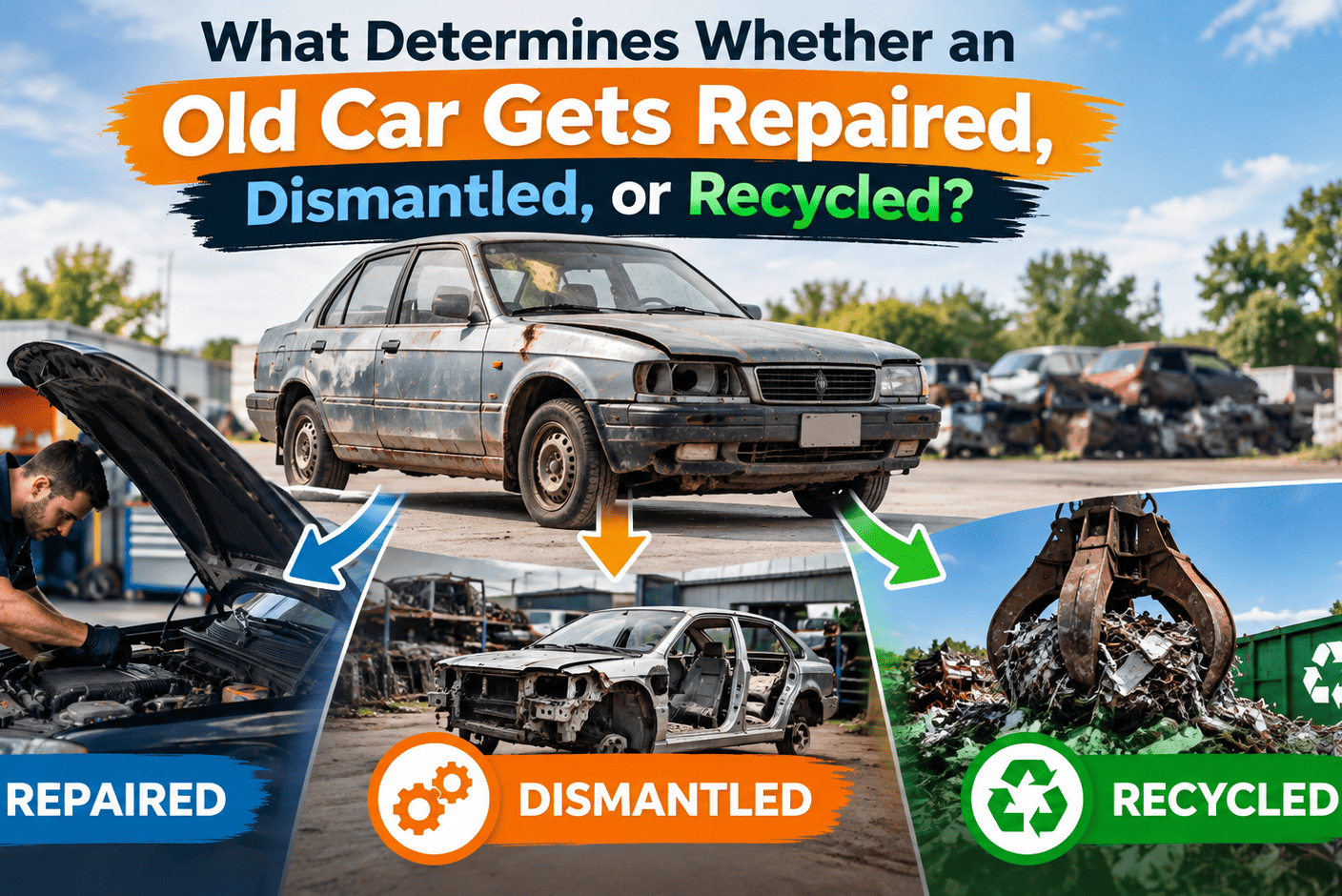
Wonder what happens to an old car? Discover how repair costs, usable parts, vehicle condition, title status, and recycling value determine its next step.
An old car sitting in a driveway or parking area can have several possible futures. It might be repaired and returned to the road, dismantled for usable parts, or sent through the recycling process to recover metal and other materials.
But what determines which path a vehicle takes?
The answer isn't simply the car's age. Vehicle condition, repair costs, parts demand, damage, title status, vehicle completeness, and recycling value can all influence what happens next.
For someone searching for cash for cars Olympia, understanding this process can also help explain why an old vehicle may still have value even when it no longer runs.
An Old Car Isn't Automatically a Junk Car
Age alone doesn't determine whether a vehicle should be repaired, dismantled, or recycled.
A 15-year-old vehicle with regular maintenance, a solid body, and a functioning engine may still be useful as a transportation vehicle. In contrast, a much newer vehicle involved in a severe collision could be uneconomical to repair.
The first question is therefore not:
“How old is the car?”
It is:
“What condition is the car in, and what would it take to make it useful again?”
This distinction is important when deciding what to do with an unwanted vehicle.
1. Repair Costs Are One of the Biggest Factors
Repairing a vehicle only makes sense when the expected benefits justify the expense.
Suppose an older sedan needs a relatively inexpensive repair, such as a battery, alternator, or starter. If the rest of the vehicle is in good condition, repairing it may be reasonable.
Now consider a vehicle that needs:
- A replacement engine
- Transmission work
- Major suspension repairs
- Extensive electrical repairs
- Body and structural repairs
- New tires and other major components
The combined repair bill can become much larger than the vehicle's practical market value.
When that happens, an owner may consider selling the vehicle instead of investing additional money into it.
This is one reason people searching for olympia cash for cars may choose to get a vehicle evaluated before deciding whether another repair is worthwhile.
2. The Vehicle's Overall Condition Matters
Two cars of the same age can have completely different outcomes because their conditions are different.
A vehicle that has been maintained throughout its life may have:
- A relatively healthy engine
- A usable transmission
- Less corrosion
- A complete interior
- Functional electronics
- Good body panels
- Usable wheels and tires
Another vehicle of the same year may have severe rust, accident damage, missing components, and long-term mechanical problems.
The second vehicle may be more suitable for dismantling or recycling.
This is why vehicle assessment should look at the entire car, not just one component.
3. Usable Parts Can Give an Old Car a Second Life
An old car doesn't necessarily have to return to the road to remain useful.
If a vehicle is no longer economical to repair, some of its components may still be usable in other vehicles.
Depending on the make, model, condition, and demand, potentially reusable components can include:
- Engines and engine components
- Transmissions
- Alternators
- Starters
- Wheels and rims
- Doors
- Mirrors
- Headlights and taillights
- Seats and interior components
- Electronic modules
- Suspension components
This is where dismantling can become an option.
A vehicle may be taken apart so usable components can be recovered before the remaining materials are processed for recycling.
4. Parts Demand Can Influence the Decision
Not every old vehicle has the same parts demand.
A common vehicle model may have many owners looking for replacement components. In that situation, a damaged vehicle can still contain parts that are useful to other drivers.
For example, a vehicle with a damaged engine might still have:
- Good doors
- Functional electronics
- Usable wheels
- Interior components
- Body panels
- Lighting assemblies
The value of those components depends on their actual condition and whether there is demand for them.
This means a vehicle that cannot be repaired economically may still have a useful role in the automotive parts market.
5. Severe Damage Can Change the Vehicle's Future
Accident damage is another major factor.
A vehicle involved in a serious collision may have damage to the frame, suspension, engine compartment, airbags, or other critical areas.
If repairing the vehicle would cost too much, it may be declared a total loss under applicable requirements.
A salvage vehicle can still have options depending on its condition and applicable state requirements. It may potentially be sold, repaired, retained, or used for parts.
So a damaged vehicle's future isn't necessarily limited to the scrapyard.
6. Title Status and Documentation Matter
A vehicle's paperwork can affect what can legally happen next.
Title status can provide important information about the vehicle's history and condition. Salvage vehicles, for example, can have specific reporting and title requirements.
This is why sellers should keep their ownership documents and accurately communicate the vehicle's status when contacting a buyer.
Having the VIN, title information, and basic vehicle history available can also make the selling process easier.
7. Vehicle Weight and Recyclable Materials Matter
When a vehicle reaches the end of its practical service life, recycling can recover materials that would otherwise be lost.
Vehicles contain materials such as:
- Steel
- Aluminum
- Copper
- Plastics
- Glass
- Rubber
- Other recyclable components
The amount and type of recoverable material can contribute to the vehicle's recycling value.
However, recycling isn't simply about putting an entire vehicle into a crusher.
Professional vehicle recycling involves handling different materials and fluids appropriately. Automotive recycling operations may need to manage fluids, batteries, tires, refrigerants, metals, and other materials according to applicable requirements.
8. Fluids and Hazardous Materials Need Proper Handling
An old vehicle can contain fluids and components that shouldn't simply be dumped or discarded.
Examples include:
- Used motor oil
- Transmission fluid
- Brake fluid
- Antifreeze
- Fuel
- Refrigerants
- Batteries
These materials can require appropriate recycling, recovery, or disposal methods.
A professional recycling process can separate reusable materials from items that require specialized handling.
9. The Vehicle's Location Can Affect Its Practical Value
Transportation is another factor people sometimes overlook.
An old vehicle may have value, but moving it can require a tow truck or other transportation equipment if it doesn't run.
The distance between the vehicle and the buyer, dismantling facility, or recycling operation can influence the overall economics of the transaction.
For an owner looking for cash for cars Olympia, working with a local buyer can make the pickup process more straightforward.
This is especially relevant for vehicles that are:
- Parked in a driveway
- Sitting in a garage
- Stuck in a yard
- Missing wheels
- Unable to start
- Damaged after an accident
10. Completeness of the Vehicle Matters
An old vehicle that's still mostly complete can have different value from one that has already been stripped of major components.
For example, consider two identical vehicles.
Vehicle A still has its engine, transmission, wheels, electronics, catalytic converter, interior, and body components.
Vehicle B has already had several major parts removed.
Even though both vehicles have the same model and year, their potential value can be different.
Before removing major components, owners should consider the overall value of the complete vehicle rather than assuming that selling individual parts separately will always produce a better result.
Repair, Dismantle, or Recycle: How the Decision Works
The process can be simplified into three possible paths.
Repair
Repair is more likely to make sense when:
- Major components remain usable
- Repair costs are reasonable
- The vehicle has a useful remaining service life
- The body and structure are in acceptable condition
- The vehicle's value justifies the investment
Dismantle
Dismantling may make sense when:
- The vehicle isn't economical to repair
- It contains desirable usable parts
- Replacement components have demand
- The vehicle has significant parts value
Recycle
Recycling becomes an important option when:
- The vehicle has little practical resale value
- Major components are no longer usable
- The vehicle is heavily damaged
- The remaining value is primarily in recyclable materials
In practice, these stages can overlap. A vehicle may have usable components removed before the remaining shell is recycled.
Why Getting a Vehicle Assessment Is Important
It's easy to look at an old car and assume it's worthless.
Maybe the engine is dead. Perhaps the transmission failed. Maybe the vehicle has been sitting outside for several years.
But those facts don't necessarily tell the entire story.
The vehicle may still contain valuable components or recyclable materials.
Before deciding what to do, collect basic information such as:
- Make and model
- Model year
- Mileage
- VIN
- Vehicle condition
- Mechanical problems
- Accident history
- Missing parts
- Title status
- Current location
Clear photographs of the vehicle can also help a buyer understand its condition.
What Happens After a Junk Car Is Picked Up?
When a vehicle is sold for dismantling or recycling, the process doesn't necessarily end with towing.
Depending on the vehicle and operation, it may be inspected first. Reusable components can be identified and removed. Fluids and certain materials can be handled appropriately, while recyclable metals and other materials can be separated for further processing.
The goal is to recover useful materials while managing potentially hazardous components responsibly.
How This Helps When Selling an Old Car in Olympia
If you're searching for buy junk cars in Olympia, understanding what happens to an old vehicle can help you approach the selling process with more realistic expectations.
A car doesn't have to be roadworthy to have value.
Its value may come from:
- Reusable parts
- Recyclable metals
- Vehicle weight
- Component demand
- Overall condition
- Completeness
- Location
The best option depends on the individual vehicle.
For some cars, repairing the problem makes sense. For others, dismantling provides the best opportunity to recover useful components. For vehicles that have reached the end of their practical life, recycling may be the most appropriate route.
Final Thoughts
An old car's future is determined by much more than its age.
Repair, dismantling, and recycling are different paths, and the right path depends on the vehicle's condition, repair costs, parts demand, damage, title status, completeness, location, and recyclable materials.
A vehicle that seems worthless at first glance may still contain useful parts or valuable recyclable materials. At the same time, spending thousands of dollars repairing a vehicle with little remaining market value may not make practical sense.
If you're considering olympia cash for cars, start by understanding your vehicle's actual condition and gathering accurate information about it. Then compare the available options rather than assuming that repair, dismantling, or recycling is automatically the right answer.
Ultimately, an old car doesn't necessarily represent the end of value. Sometimes its next purpose is simply different from the one it had when it was first purchased.