
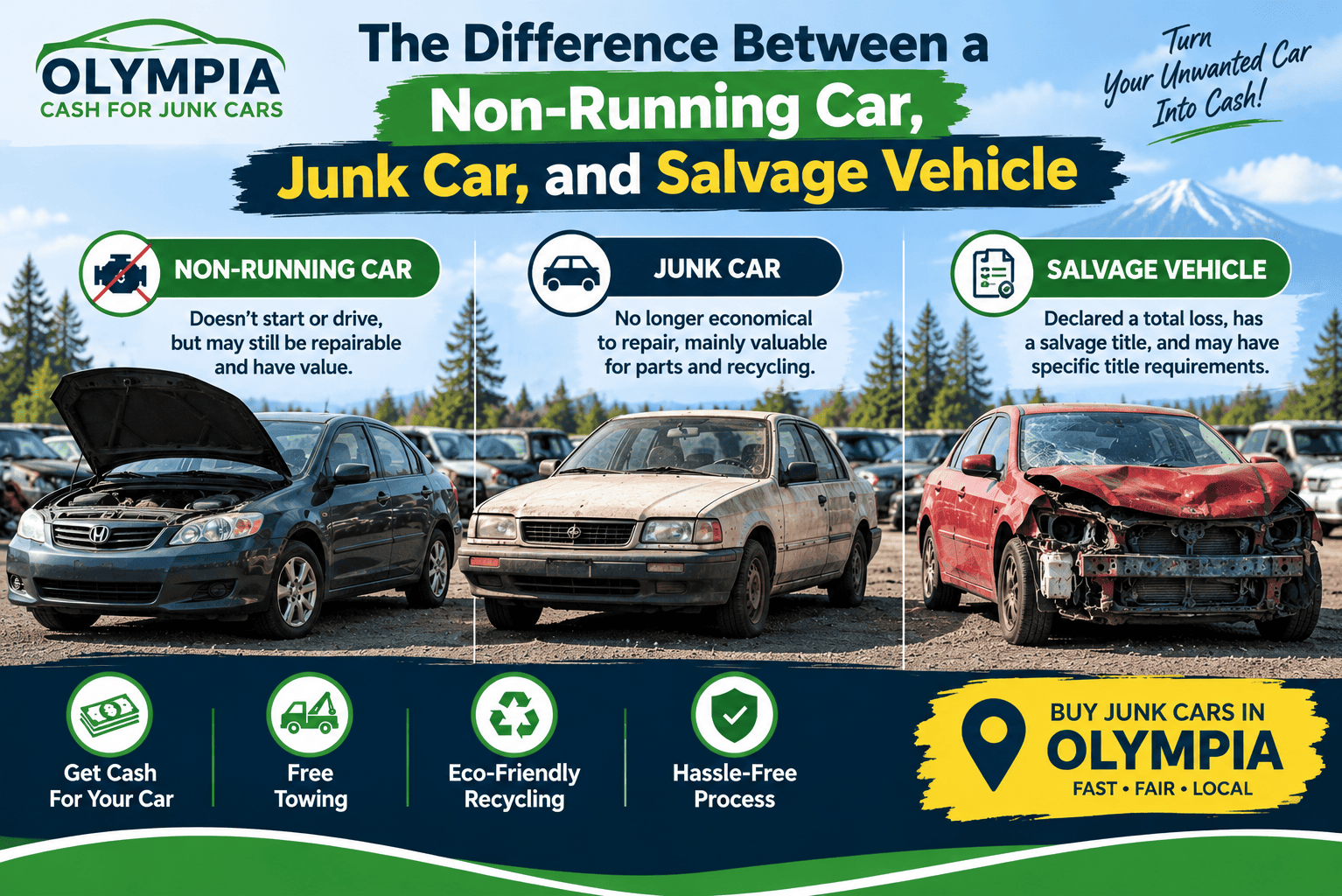
Understand how non-running, junk, and salvage vehicles differ and discover the factors that can affect their value and selling process in Olympia.
When a vehicle stops running, many owners immediately call it a “junk car.” But a non-running car, junk car, and salvage vehicle are not necessarily the same thing.
These terms describe different situations. Understanding the difference can help you determine what options you have when you're ready to sell an unwanted vehicle, especially if you're searching for cash for cars Olympia or looking for a local company that can buy junk cars in Olympia.
A vehicle that doesn't start might still be repairable. A junk vehicle may have little value beyond its parts and recyclable materials. A salvage vehicle, meanwhile, may have an official title status resulting from major damage or a total-loss determination.
Let's look at the differences in detail.
What Is a Non-Running Car?
A non-running car is simply a vehicle that cannot currently operate under its own power.
There can be many reasons a vehicle won't start or drive. Some are relatively minor, while others can make repairs uneconomical.
Common reasons include:
- Dead or failed battery
- Failed starter
- Fuel-system problems
- Engine failure
- Transmission failure
- Electrical problems
- Accident damage
- Severe overheating
- Long-term neglect
- Flood or water damage
The important point is that non-running does not automatically mean junk.
For example, a 2018 sedan with a failed starter could technically be a non-running vehicle, but it may still have significant value as a conventional used vehicle once repaired.
On the other hand, an older vehicle with a severely damaged engine, extensive rust, missing components, and years of neglect may make more sense as a junk vehicle.
Does a Non-Running Car Still Have Value?
Yes. A vehicle doesn't have to run to have value.
Depending on its condition, a non-running vehicle may have value because of its:
- Engine and transmission
- Wheels and tires
- Electronics
- Body panels
- Interior components
- Catalytic converter
- Recyclable metal
- Other usable components
Therefore, if your car doesn't start, don't automatically assume that it has no value.
What Is a Junk Car?
The term junk car generally refers to a vehicle that is no longer economically practical to repair or operate and may primarily have value as a source of parts and recyclable materials.
However, the exact meaning can depend on the context and applicable state requirements.
A vehicle can be considered a junk vehicle because of its age, damage, condition, or low fair market value compared with its scrap value.
This is different from simply saying that a car doesn't run.
For example:
Vehicle A: A 2020 car with a dead battery and a good engine may be non-running but still worth repairing.
Vehicle B: A 2005 vehicle with severe damage, missing components, and little market value may be more appropriately considered a junk vehicle.
The two vehicles have very different situations even though neither is currently being driven.
What Is a Salvage Vehicle?
A salvage vehicle is different because the term can refer to an official vehicle status.
A salvage vehicle is generally a vehicle that has been damaged to the extent that it has been declared a total loss under applicable rules. This can happen following a major collision, flood, fire, theft recovery, or another significant event.
This distinction is important because a vehicle can be:
- Non-running but not salvage
- Salvage but potentially repairable
- Non-running and salvage
- Junk and salvage-related depending on its history and status
The terms shouldn't automatically be treated as interchangeable.
Salvage Does Not Always Mean Completely Destroyed
A salvage vehicle may look severely damaged, but that doesn't necessarily mean every component is worthless.
Depending on its condition and title status, a salvage vehicle may still have usable parts or may potentially be repaired according to applicable requirements.
However, title and reporting requirements can apply to salvage vehicles. Sellers should verify the current requirements with the Washington State Department of Licensing before completing a transaction.
Non-Running Car vs. Junk Car vs. Salvage Vehicle
Here's a simple way to understand the difference:
| Vehicle Type | Basic Meaning | Can It Have Value? | Typical Situation |
|---|---|---|---|
| Non-Running Car | Vehicle currently doesn't operate | Yes | Mechanical or electrical problem |
| Junk Car | Vehicle with little practical repair/resale value and potential parts or recycling value | Yes | Old, damaged, heavily worn, or inoperable vehicle |
| Salvage Vehicle | Vehicle officially declared a total loss under applicable rules | Yes | Major accident or other significant damage |
The biggest difference is that “non-running” describes the vehicle's operating condition, while “salvage” can describe its official title or status history.
“Junk car” generally describes a vehicle whose practical value may be concentrated in parts and recyclable materials.
Can a Non-Running Car Become a Junk Car?
Yes.
Imagine a vehicle that stops running because of a transmission failure.
Initially, it may simply be a non-running car.
The owner could obtain a repair estimate and discover that repairing the transmission costs more than the vehicle is worth. If the car also has significant rust, worn components, high mileage, and other problems, the owner may decide that selling it as a junk vehicle makes more sense.
In that situation, the vehicle's classification in everyday language can change based on its condition and economic value.
This is why it's useful to evaluate the entire vehicle rather than focusing on one mechanical problem.
Can a Salvage Vehicle Be Sold?
A salvage vehicle may be sold, but the transaction can involve additional documentation and title considerations.
A salvage title or brand can also affect the vehicle's future use and value. For that reason, sellers should accurately disclose the vehicle's status and maintain the appropriate ownership documents.
Because title requirements can depend on the vehicle's circumstances, it's important to verify current Washington requirements before selling or transferring ownership.
What Determines the Value of a Non-Running or Junk Car?
The fact that a vehicle doesn't run is only one part of the valuation process.
1. Vehicle Condition
The overall condition of the body, frame, interior, and mechanical components can influence what a buyer can recover from the vehicle.
2. Usable Parts
A non-running vehicle may still contain components that can be reused or sold.
3. Vehicle Weight
Vehicles contain recyclable materials such as steel and aluminum. The amount and type of material can contribute to the vehicle's recycling value.
4. Damage
Accident, flood, fire, and corrosion damage can affect the condition and potential use of the vehicle.
5. Missing Components
A complete vehicle can have different value from one that has already had major components removed.
6. Vehicle Location
Transportation and towing logistics can affect the economics of purchasing and moving an unwanted vehicle.
7. Title and Documentation
Having appropriate ownership documentation can make the selling process easier. Make sure your vehicle information and ownership records are accurate before completing a sale.
What Should You Do Before Selling?
Before contacting a buyer, collect as much accurate information about the vehicle as possible.
Have these details available:
- Make and model
- Model year
- Approximate mileage
- Vehicle Identification Number (VIN)
- Current condition
- Known mechanical problems
- Accident or damage history
- Missing parts
- Title information
- Vehicle location
Taking photographs can also be useful. Include pictures of the exterior, interior, engine compartment, wheels, and any major damage.
Being transparent about the vehicle's condition can make the quoting process more straightforward.
Looking for Cash for Cars in Olympia?
If you're searching for cash for cars Olympia, don't assume that your vehicle has no value simply because it doesn't start.
A non-running car may still have valuable components. A damaged vehicle may have parts that can be recovered. And a vehicle that is no longer practical to repair may still have value through recycling.
If you're searching for olympia cash for cars, provide accurate information about the vehicle so the buyer can better understand its condition.
For people who want to buy junk cars in Olympia, understanding the distinction between non-running, junk, and salvage vehicles is equally important. These categories can affect paperwork, valuation, potential use of the vehicle, and the next steps in the selling process.
Final Thoughts
A car that doesn't run isn't automatically a junk car, and a junk car isn't necessarily the same thing as a salvage vehicle.
A non-running car describes a vehicle that currently cannot operate.
A junk car generally describes an old, damaged, or otherwise uneconomical vehicle whose remaining value may come largely from parts and recyclable materials.
A salvage vehicle refers to a vehicle that has been declared a total loss under applicable rules and has associated title or reporting requirements.
Understanding these differences can help you describe your vehicle accurately, gather the right information, and determine which selling options may apply to your situation.
If you're ready to move on from an old or damaged vehicle, start by assessing its actual condition, checking your ownership documents, and getting a quote based on the vehicle as it exists today.