
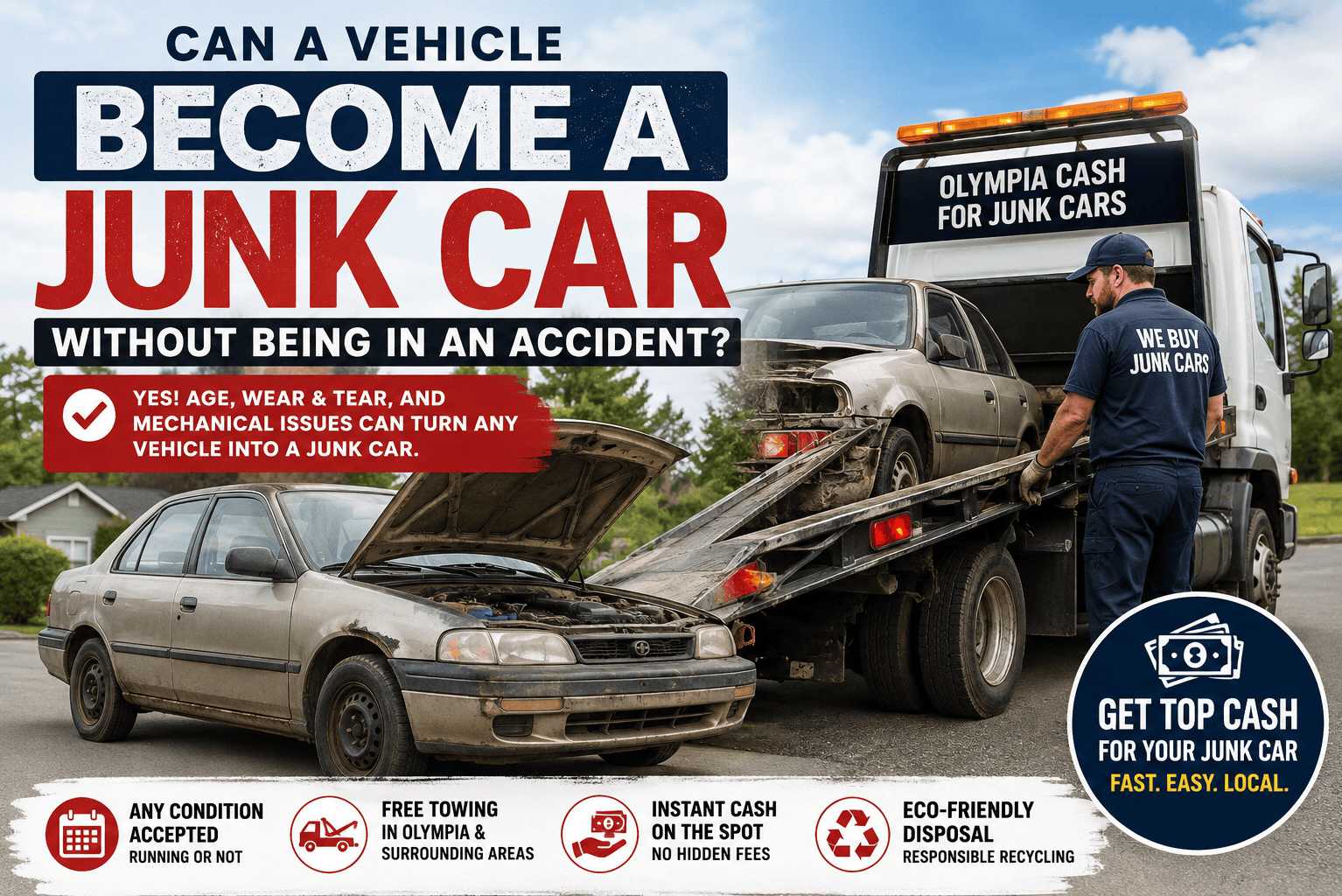
Is your car no longer worth repairing? Explore how age, mechanical problems, corrosion, and repair costs can turn an ordinary vehicle into a junk car.
When people hear the phrase “junk car,” they often picture a vehicle that has been badly damaged in a crash. However, a car does not need to be involved in an accident to become a junk vehicle. Age, mechanical problems, neglect, rust, high repair costs, and long periods of sitting unused can all turn an otherwise ordinary vehicle into one that is no longer practical to keep.
For vehicle owners in Olympia, understanding what makes a car a junk car can help when deciding whether to repair, sell, donate, or remove an unwanted vehicle. In many cases, continuing to invest money into an older vehicle simply does not make financial sense.
What Actually Makes a Car a Junk Car?
A junk car is generally a vehicle that has little practical value as a dependable means of transportation but may still have value through its parts, metal, or recyclable materials. Its condition matters more than whether it has ever been in an accident.
A vehicle may be considered a junk car when its repair costs are higher than its realistic market value. For example, an older sedan with a failed transmission may technically be repairable, but replacing the transmission could cost thousands of dollars. If the car is already worth very little, the owner may decide that repairing it is not worthwhile.
This is one reason people searching for buy junk cars in Olympia may find that buyers are interested in vehicles that are no longer roadworthy, even when those vehicles have never been involved in a collision.
Age Can Turn a Good Car Into a Junk Vehicle
Every vehicle eventually reaches a point where age begins to affect its reliability. Older cars often experience repeated problems with engines, transmissions, suspension components, electrical systems, brakes, cooling systems, and other major parts.
An older vehicle that requires frequent repairs can become expensive to maintain. Even if each individual repair seems manageable, the combined cost over several months or years can exceed the vehicle's remaining value.
Age alone does not automatically make a vehicle a junk car. A well-maintained older vehicle may still have significant value. However, when age is combined with poor mechanical condition, worn components, and expensive repairs, selling the car for its remaining value may be the more sensible option.
Mechanical Failure Is a Common Reason
A major mechanical failure can make a vehicle uneconomical to repair.
- Failed engine
- Broken transmission
- Severe electrical problems
- Damaged suspension
- Overheating issues
- Failed catalytic converter
- Major brake system problems
- Persistent oil or coolant leaks
Some mechanical issues can be repaired affordably, while others require substantial investment. The decision depends on the vehicle's age, mileage, condition, repair cost, and current market value.
A car with a failed engine, for example, may still contain valuable components. Its body panels, wheels, interior, catalytic converter, electronics, and other parts may have value even though the vehicle cannot be driven.
Rust and Corrosion Can Reduce a Vehicle's Value
A vehicle does not have to crash to suffer serious physical deterioration. Rust can gradually damage a car over time.
Surface rust may not be a major concern, but extensive corrosion can affect the body, frame, suspension mounting points, brake lines, and other structural areas. Once corrosion becomes severe, repairs can become difficult and expensive.
Vehicles that have spent years exposed to moisture, poor storage conditions, or road elements may eventually reach a point where restoration costs more than the car is worth.
For owners considering junk car removal Olympia, extensive rust is one of the conditions worth mentioning when describing the vehicle to a buyer.
A Car That Has Sat for Years May Become a Junk Car
Sometimes a vehicle becomes a junk car simply because nobody has used it for a long time.
A car that sits in a driveway, garage, backyard, or parking area for years can develop multiple problems. Tires can deteriorate, batteries can fail, fluids can become contaminated, seals can dry out, rodents may damage wiring, and brakes can develop corrosion.
Even if the vehicle was running when it was parked, bringing it back to reliable road condition may require more money than the owner wants to spend.
This is especially common with vehicles that were originally parked because of a small mechanical issue. Over time, that small issue can become several problems, making the vehicle increasingly difficult to restore.
High Repair Costs Can Change the Equation
One of the most important questions to ask is not simply, “Can this car be repaired?” but rather, “Is repairing this car financially reasonable?”
Almost any vehicle can potentially be repaired if enough money is invested. The real issue is whether the repair makes sense compared with the vehicle's value.
For example, imagine an older car worth $2,500 in good running condition. If it needs $4,000 in major repairs, spending that amount may not be an attractive option. The owner may instead choose to sell the vehicle in its current condition.
This is where Olympia cash for cars services can provide an alternative for owners who do not want to spend more money restoring an aging or non-running vehicle.
Electrical Problems Can Make Older Cars Difficult to Keep
Modern vehicles rely on extensive electrical systems. A serious electrical problem can sometimes be challenging to diagnose and expensive to repair.
A vehicle may have problems with wiring, sensors, control modules, lights, starting systems, or other electronic components. When several electrical issues occur at once, determining the exact cause can become time-consuming.
For an older vehicle with a low market value, a major electrical repair may not be worth the expense. In such situations, the car may have greater value as a source of usable parts and recyclable materials.
Missing or Expensive Parts Can Also Be a Problem
Some older or discontinued vehicles become difficult to maintain because replacement parts are hard to find.
Even when parts are available, they may be expensive. Owners may also have difficulty finding qualified technicians who are familiar with an older model.
If a vehicle requires several uncommon parts and extensive labor, keeping it on the road may become impractical. Selling it to a buyer who can dismantle, recycle, or reuse its components may be a better solution.
Does Low Mileage Always Mean a Car Is Valuable?
Not necessarily.
Low mileage can be attractive, but mileage is only one factor in determining a vehicle's condition. A car with low mileage that has been sitting unused for many years may still have serious problems.
Rubber components can deteriorate with age, fluids can degrade, tires can become unsafe, and seals can fail. Meanwhile, a higher-mileage vehicle that has received consistent maintenance may remain dependable.
When deciding whether a vehicle is a junk car, owners should consider its overall condition rather than focusing on mileage alone.
What Happens After You Decide to Sell?
Once you determine that repairing the vehicle no longer makes financial sense, the next step is finding a reputable buyer and understanding the selling process.
A professional buyer may ask for basic information such as the vehicle's make, model, year, condition, mileage, and whether it runs. Being honest about mechanical or physical problems helps the buyer provide a more realistic estimate.
If the vehicle cannot be driven, ask about pickup arrangements. Many junk car buyers provide towing or vehicle removal services, which can make the process easier for owners with non-running cars.
Before completing the sale, make sure you understand the paperwork and payment process. Keeping records related to the sale can also be helpful.
You Don't Need an Accident to Have a Junk Car
A serious accident is only one possible reason a vehicle becomes a junk car. A car can reach the end of its useful life because of age, mechanical failure, rust, neglected maintenance, electrical problems, expensive repairs, or years of sitting unused.
The key question is whether the vehicle still makes financial and practical sense to repair and operate.
If an older or damaged vehicle is taking up valuable space and continuing to repair it no longer seems worthwhile, selling it in its current condition may be a practical alternative. For Olympia-area vehicle owners, researching local options for buy junk cars in Olympia, junk car removal Olympia, and Olympia cash for cars can help determine what choices are available.
A vehicle does not have to be completely destroyed to have reached the end of its useful life. Sometimes, recognizing that fact early can save an owner time, repair expenses, storage space, and unnecessary frustration.